
There are moments in life when you open the cupboard and there is genuinely nothing left. No backup plan, no savings, no tin of baked beans at the back of the shelf. Just the end. The widow in 1 Kings 17 knew that feeling better than most of us ever will. Ps Chris Smith opens this story not as ancient history but as a word for right now — a reminder that the God who met her in that moment is the same God walking with us today.
The God Who Cannot Be Contained: “I Am”
Before we get to the widow, Chris anchors everything in a name. In Exodus 3, Moses — a man hiding from his past, running sheep in the middle of nowhere — encounters a burning bush. God speaks to him and sends him back to the very place he has fled. When Moses asks who he should say has sent him, God replies:
I am who I am. This is what you are to say to the Israelites: “I am has sent me to you.” (Exodus 3:14)
It is not a very descriptive answer, and yet it is the most descriptive answer possible. God is saying: I cannot be labelled. My limits cannot be described. My power cannot be measured. I am.
That same God, Hebrews tells us, has not changed:
Jesus Christ is the same yesterday and today and for ever. (Hebrews 13:8)
The God who parted the Red Sea, who healed a woman who had been bleeding for years the moment she touched the hem of his garment, who called a dead man out of a tomb — that is the God who lives in you and walks with you today. He has not grown weaker. He has not grown more forgetful. He is still I Am.
A Widow With One Meal Left
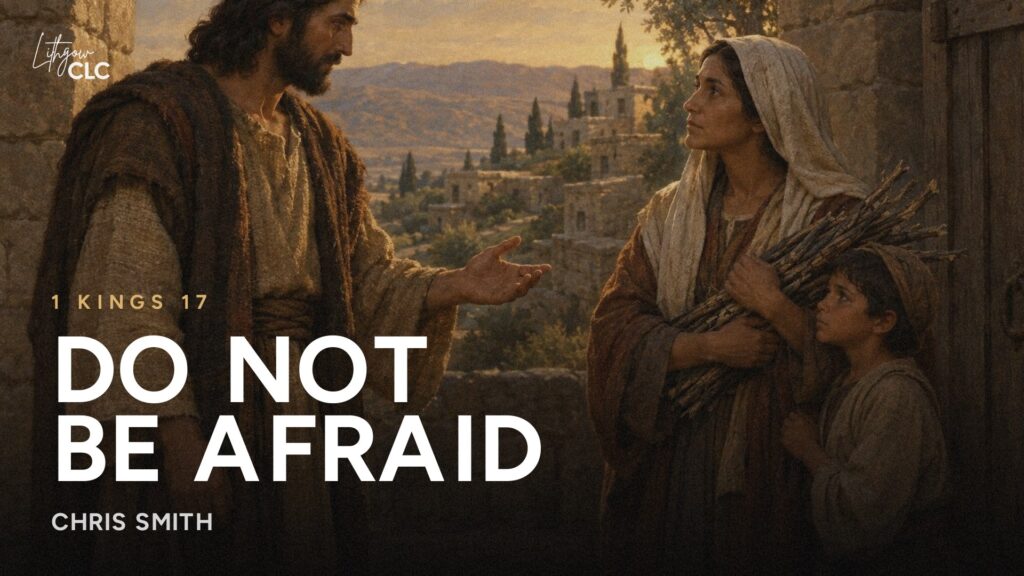
In 1 Kings 17:8–16, God tells the prophet Elijah to travel to Zarephath, where a widow will provide for him. When Elijah arrives, he finds a woman gathering sticks outside the city gate. He asks her for water and bread. Her reply is devastating in its honesty:
As surely as the Lord your God lives, I don’t have any bread — only a handful of flour in a jar and a little olive oil in a jug. I am gathering a few sticks to take home and make a meal for myself and my son, that we may eat it and die. (1 Kings 17:12)
This woman is not being dramatic. She is a widow in the middle of a famine, with no income, no savings, and no support. She has a plan: gather the sticks, go home, bake the last of the flour and oil, eat with her son, and wait. She has thought about who might go first. That is what she woke up to that morning.
She was not an Israelite. She did not even believe in God. She was a gentile woman at the very bottom of the social order — and yet God sent Elijah specifically to her. Not to a leader, not to a princess, not to one of his own people. To her.
Do Not Be Afraid
Elijah looks her in the eye and says two things before anything else: do not be afraid. Go and do what you planned, but first make a small loaf for me. Then God promises:
The jar of flour will not be used up and the jug of oil will not run dry until the day the Lord sends rain on the land. (1 Kings 17:14)
Chris paused on those words — do not be afraid — because he felt God saying exactly the same thing to each person in the room. Whatever you are facing, whatever is ahead of you, whatever plans you have made: do not be afraid. Do not fear. And coming from I Am, that is not a platitude. It is a statement of fact about who God is.
He pointed to Matthew 6, where Jesus makes the same case to a crowd of worried people:
Therefore I tell you, do not worry about your life, what you will eat or drink; or about your body, what you will wear. Is not life more than food, and the body more than clothes? Look at the birds of the air; they do not sow or reap or store away in barns, and yet your heavenly Father feeds them. Are you not much more valuable than they? (Matthew 6:25–26)
Valuable. That word matters. Something valuable is protected, watched over, cared for. Chris drew an illustration from a 1982 Peter Brock Bathurst Holden Commodore that sold at auction for $2.1 million. That car goes home on the back of a trailer. It lives in a climate-controlled garage. Someone polishes the tyres once a week. Why? Because of what it is worth. And God says that is how he looks at you — multiplied by infinity. He knows how many hairs are on your head. He has more thoughts about you than there are grains of sand on every shore in the world. You are not forgotten. You are not overlooked. You are valuable.
The Miracle of the Daily Jar
What happened next in the story is remarkable, and not just because of the miracle itself. The widow went and did what Elijah said:
So there was food every day for Elijah and for the woman and her family. For the jar of flour was not used up and the jug of oil did not run dry, in keeping with the word of the Lord spoken by Elijah. (1 Kings 17:15–16)
But notice what God did and did not do. He did not give her a barrel of flour and a barrel of oil and tell her to sort herself out for the next two years. He gave her the same jar and the same jug — enough for today. She would empty them, put them back in the cupboard, go to sleep, and wake up to find them full again. Day after day after day.
Chris asked why God would do it that way. Why not just fill the storeroom and be done with it? Because if the storeroom was full, that is where her eyes would go. She would be watching the level drop, measuring what was left, calculating how long it would last. Her faith would be in the barrel — in what she could see and smell and measure. Instead, God arranged things so that every single morning her faith had nowhere to go but up. The provision was him, not a supply she could manage on her own.
Chris shared from his own early years of ministry, when he and his wife were just starting out with very little income and a growing family. He used to ask God to just drop ten million dollars in his account so he would never have to bother him again. It never happened. What did happen was that on the mornings when there was nothing, he would wake up to find an envelope slipped under the door of their little unit in Blacktown. I am.
His Timing Is His Timing
Zarephath was 137 kilometres from where Elijah started. At a walking pace of twenty kilometres a day, that is at least a week’s journey. God could have sent Elijah somewhere closer. But when did Elijah arrive? Not the day after the widow had eaten her last meal. Not the week before. The very day she was facing the end.
That is not coincidence. That is God, who knows where you are right now, who knows the day you were born and the day you will die, who walks your whole life with you and who will bring what you need at exactly the right moment. His timing feels slow to us. We would like it much faster. But his timing is his timing, and it is always perfect.
The widow’s obedience is also worth noting. She had one day’s food left and Elijah asked her to give the first portion to him — a stranger. She did not bargain. She did not ask him to prove it first. She went and did as he said. That obedience, Chris observed, is a whole other sermon. But it is a picture of what it looks like to trust I Am when it does not yet make sense.
Look Up
So where do we put our eyes? Not in the barrel. Not in the bank account. Not in what we can see or feel or measure. Not in what the news says or what the report says or what the internet says. Chris closed with a simple call:
Look up. Seek first his kingdom. Put what you are carrying — the medical battle, the financial pressure, the broken relationship, the exhausting season — into the hands of him who is I Am. He has not forgotten you. He is not less powerful than he was. He knows what you need before you even ask. And when he decides to act, he is one hundred per cent trustworthy, one hundred per cent a keeper of promises, one hundred per cent able.
The drought in Elijah’s time lasted more than two years. Not once did the jar run dry. Not once did God let that woman down. He will not let you down either.
Whatever you are facing this morning, hear the word God spoke to a gentile widow with nothing left: do not be afraid. Do not fear. I Am.