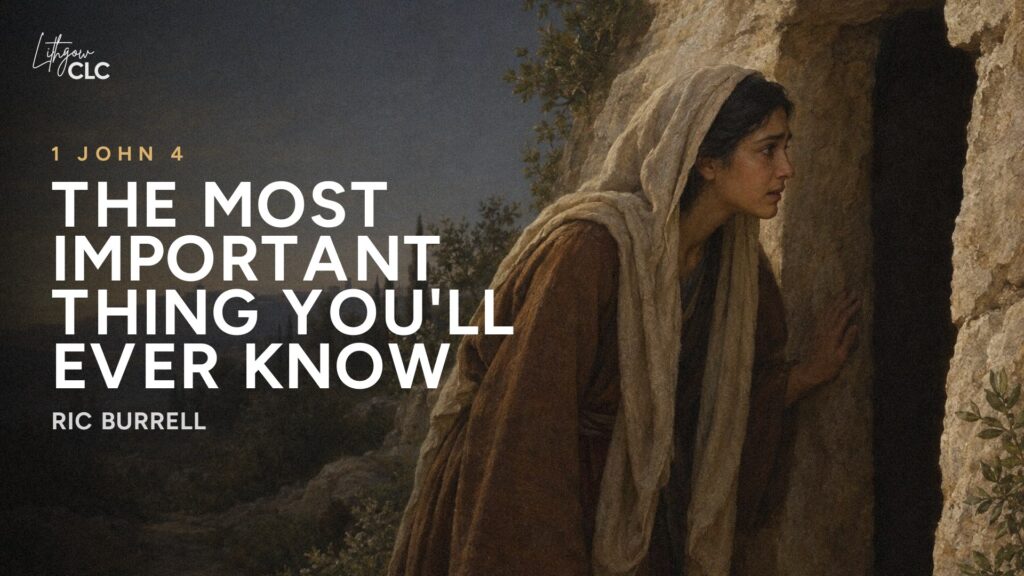

Ps Ric Burrell, Senior Pastor of Strong Nation Church, opened his message with a simple but arresting claim: the most important thing any Christian can ever dwell on is not what we do for God, but what God has done for us. Specifically, his love for you. Everything else flows from there.
John, the disciple who famously called himself “the one whom Jesus loved,” is easy to poke fun at. Ric noted that on the most extraordinary morning in human history — the discovery of the empty tomb — John’s account pauses to mention that he outran Peter. Five times in his gospel, John refers to himself as the disciple Jesus loved. That might look like pride, but Ric suggested it reveals something far more important: John had understood something the others were still grasping for. He knew he was deeply, personally loved by Jesus, and that knowledge shaped everything about him.
John returned to this theme again and again in his letters. In 1 John 4:7–19, he builds his entire ethic of love on one foundation:
This is love: not that we loved God, but that he loved us and sent his Son as an atoning sacrifice for our sins. (1 John 4:10)
We love because he first loved us. (1 John 4:19)
As Ric put it, the most theologically powerful song ever written is still Jesus Loves Me. Everything stems from that.
He Loved Us, So He Created Us
The first thing to understand about God’s love is that it is the reason you exist. God did not create humanity as an afterthought or a workforce. He created you because he wanted a family he could love. Ric pointed to Psalm 139 to show just how deliberate that act was:
For you formed my inward parts; you knitted me together in my mother’s womb. I praise you, for I am fearfully and wonderfully made. (Psalm 139:13–14)
God crafted your personality, your gifts, your dreams, your particular way of seeing the world. Before you drew a breath, he knew you. Ric used a vivid illustration: what makes your grandmother’s best meal the best? She’ll tell you it’s the love. The vital ingredient is love. In the same way, God was putting love into the very substance of who you are as he formed you.
We are not primarily created to worship God or to preach. We are created because God wanted to love us. Worship flows from that — not as a duty performed for a taskmaster, but as a gift given back to someone who first gave everything to you.
He Loved Us, So He Saved Us
Sin separated humanity from God, but his love would not leave us there. Ric put it plainly: God so loved the world that he gave Jesus to die and take the punishment for sin. The cross is not merely a display of suffering — it is a perfect display of love.
But God demonstrates his own love for us in this: while we were still sinners, Christ died for us. (Romans 5:8)
Greater love has no one than this: to lay down one’s life for one’s friends. (John 15:13)
Ric described God as “the hound dog of heaven” — the one who pursues you even when you walk away. CS Lewis put it this way: religion is humanity’s pursuit of God, but Christianity is God’s pursuit of humanity. He told a story from his own church of a family who had been drawn in simply because a young woman’s character impressed her employer, who then wanted to know what shaped her. One thing led to another, and people who hadn’t been looking for God found themselves unable to stop looking. That is what his love does.
He Loved Us, So He Adopted Us
God does more than forgive sin. He brings you into his family.
See what great love the Father has lavished on us, that we should be called children of God. (1 John 3:1)
In the Greco-Roman world of the New Testament, an adopted child was in some ways considered closer to the father than a biological child — because the adoption was entirely on purpose. The father chose them. The adopted child received the inheritance immediately.
Paul captures this in Romans 8:15, where he uses the Aramaic word Abba — daddy — to describe how we can address God. That word, embedded in a Greek text written by a man who was also a Roman citizen, is almost certainly the word Jesus himself used. It speaks of extraordinary intimacy.
Ric drew this out through the parable of the prodigal son. The younger son rehearses his speech on the way home — he’ll ask to be taken on as a servant, because he knows he has forfeited everything. But the father interrupts him before he can finish:
You will not be my servant. You are my son.
The father throws a robe over him, puts a ring on his finger, and calls for a celebration. That, Ric said, is the gospel. God does not want more servants. He wants sons and daughters. We serve because we are his children, not in order to become worthy of him. We can walk boldly into God’s presence not as beggars, but as children who belong there.
He Loved Us, So He Sent Us
God’s love does not end with us. It is meant to flow through us and beyond us.
As the Father has sent me, even so I am sending you. (John 20:21)
All authority in heaven and on earth has been given to me. Therefore go and make disciples of all nations… And surely I am with you always, to the very end of the age. (Matthew 28:18–20)
God has placed particular gifts in you, shaped your story, and positioned you in your street, your workplace, your family — not by accident, but because he has a mission for you. He is not sending you out alone. The Holy Spirit, Ric said, is God making himself available full-time to every human being, just as Jesus once made himself available walking the roads of Galilee. He is here now, wanting to show you things, grow what he has planted in you, and open doors at exactly the right moment.
Ric’s encouragement was straightforward: when God opens a door, walk through it. When the door stays shut, don’t force it. But be ready, because he will open it. He loves you enough to entrust his own message to you.
Living from Love
Ric closed by bringing it all together. Whether you are in a season that feels like preparation, or one that feels like crisis, or one where God’s love seems like something you once knew but can’t quite reach right now — the foundation does not change. You were created because he loved you. You were saved because he loved you. You were adopted because he loved you. You were sent because he loves you and loves the people around you.
If you are struggling to love difficult people, Ric’s observation is worth sitting with: the times he has battled most with loving others are the times he has forgotten that God first loved him — knowing everything about him, including the thoughts no one else can see. When that truth is fresh, he said, you find you can love anyone.
The poem he quoted says it well:
Could we with ink the ocean fill, and were the skies of parchment made, were every stalk on earth a quill, and every man a scribe by trade — to write the love of God above would drain the ocean dry; nor could the scroll contain the whole, though stretched from sky to sky.
That is the love God has for you. Let it be fresh today.