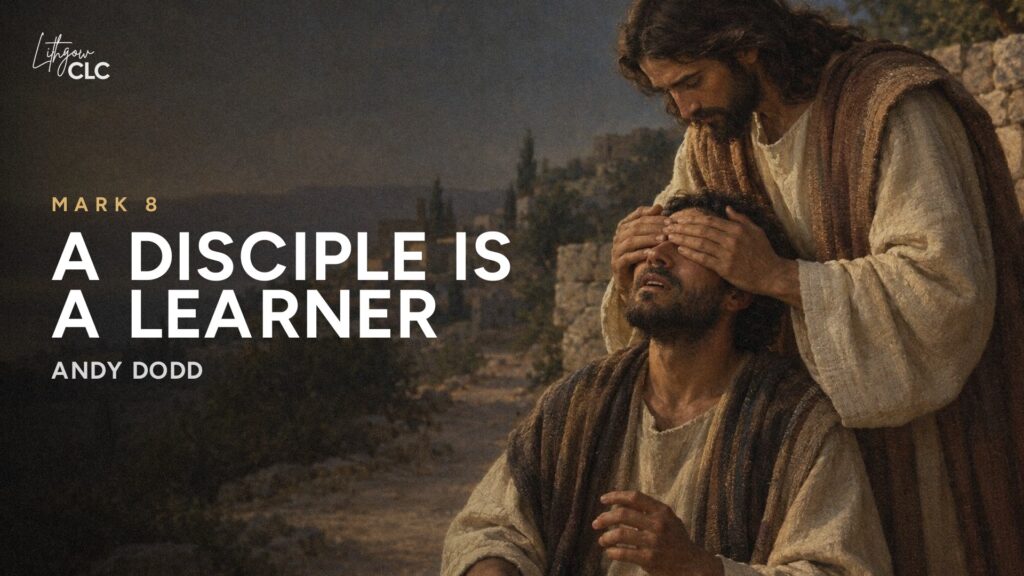

There is a difference between gathering information and actually being formed by it. You can watch Gordon Ramsay cook on YouTube without becoming a good cook. You can follow fitness accounts on Instagram without getting fit. Information, no matter how abundant or accessible, does not change you until you actually engage with it, practise it, and remain open to being corrected along the way. Ps Andy opened this message with that simple but confronting idea, and then turned it towards something much more significant: what it means to be a disciple of Jesus.
The goal is to become like the teacher
Jesus put it plainly in Luke 6:
Can the blind lead the blind? Will they not both fall into a pit? The student is not above the teacher, but everyone who is fully trained will be like their teacher. (Luke 6:39-40)
The goal of following Jesus is not simply to know more about him. It is to become like him. To think how he thinks. To treat people how he treats people. To respond to difficulty the way he responds to difficulty. To love the way he loves and to live dependent on the Spirit the way he did. As 2 Corinthians 3:18 reminds us, we are being transformed into Christ’s image by the Spirit. This is not something we achieve through our own effort. God does the transforming as we respond to him.
In the ancient world, a disciple did not pick up a teacher’s ideas as a side interest. When Jesus called his disciples, they left everything to follow him. As they walked with him, they began to think like him, talk like him, and even walk like him. People could look at a disciple and know whose student they were, just from the way they carried themselves. That is what discipleship means.
Seeing in part is not the same as seeing clearly
Mark 8 holds two stories that belong together. In the first, Jesus heals a blind man in two stages. He touches the man’s eyes and asks what he sees. The man replies:
I see people; they look like trees walking around. (Mark 8:24)
Jesus touches him again, and this time his sight is fully restored. Straight after this, Peter makes his famous confession that Jesus is the Messiah. It is the first time in Mark’s gospel that a disciple grasps who Jesus truly is. But then Jesus begins to explain that the Messiah must suffer, be killed, and rise again after three days. And Peter pulls him aside and rebukes him.
Think about that for a moment. Peter has just correctly identified Jesus as the Messiah. And now he is correcting the Messiah. Jesus turns and says:
Get behind me, Satan. You do not have in mind the concerns of God, but merely human concerns. (Mark 8:33)
Bible scholars often read these two stories together deliberately. The blind man sees partially before he sees clearly. Peter sees that Jesus is the Messiah, but he cannot yet see the full picture of what that means. He has genuine insight, but his understanding is incomplete. The problem was not that Peter could not see anything. The problem was that he thought he could see everything.
There is a well-known concept in psychology called the Dunning-Kruger effect, which describes how people who know a little about a subject often overestimate how much they actually understand. Peter had enough knowledge to recognise the Messiah, but not enough to understand the Messiah’s mission. He needed to remain teachable. And so do we.
Asking questions does not weaken faith
Sometimes we treat the Christian life as though maturity means having all the answers. If someone asks a hard question, the temptation is to shut it down with “just have faith” or “because the Bible says so.” But that is rarely the most helpful response, and it is not how the early believers approached their own faith.
When Paul and Silas arrived in Berea after being driven out of Thessalonica, they went to the synagogue and opened the scriptures. The response of the Berean Jews was remarkable:
Now the Berean Jews were of more noble character than those in Thessalonica, for they received the message with great eagerness and examined the scriptures every day to see if what Paul said was true. (Acts 17:11)
They questioned Paul, of all people, and checked everything he said against the scriptures. And as a result, many of them believed. Asking questions did not lead them away from faith. It led them deeper into it. Their humility in searching and examining produced life transformation, not just for Jewish people but for prominent Greek women and many Greek men as well, and the gospel continued to spread.
There are genuine tensions in the Christian faith that we hold in both hands at the same time. God’s sovereignty and human responsibility. Grace and obedience. These things can seem like opposites but both are true. A disciple who is willing to wrestle with difficult things, listen carefully, investigate scripture, and admit when they do not know something is far better placed to help others follow Jesus than one who pretends every question has a tidy answer.
Keep the L plates on
None of us graduate from being a learner. None of us ever reach a point where we are too experienced, too mature, or too knowledgeable to be taught something new. The very word translated “disciple” in the New Testament carries the meaning of a learner, a student, an apprentice, one who follows and learns from a teacher. That is what we are, always.
Think of a diamond. If you look at it from one angle, you see some of its faces. Turn it, and you see more. God often wants to show us something we already understand from a different angle, to reveal another aspect of it. That is how discipleship works. It is not about knowing one fixed answer. It is about pursuing a living relationship with a God who continues to shape, adjust, and transform us to be more like Jesus.
The question to carry into this week is a simple one: Lord, what are you teaching me? What is he trying to show you through this season? What is he trying to form in you? We can only ask that question if we are actually open to the answer, and open to the possibility that there is still more to learn.
As Andy reminded the church, this is not just a personal exercise. We are all called to be disciples who make disciples. Whether that is around your dinner table with your kids, over a coffee with a friend, or welcoming someone new through the church doors, the responsibility belongs to all of us. And as we commit to that, with humility and a willingness to keep learning, the expectation is that God will show us things we have never seen before.