Getting Started
Think of a time you prepared carefully for something — a trip, a job interview, a big event. How did that preparation shape the outcome, and what did it feel like if things didn’t go quite as planned?
Read the Word
Matthew 4:17–22
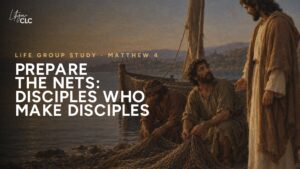
From that time on Jesus began to preach, “Repent, for the kingdom of heaven has come near.” As Jesus was walking beside the Sea of Galilee, he saw two brothers, Simon called Peter and his brother Andrew. They were casting a net into the lake, for they were fishermen. “Come, follow me,” Jesus said, “and I will send you out to fish for people.” At once they left their nets and followed him. Going on from there, he saw two other brothers, James son of Zebedee, and his brother John. They were in a boat with their father Zebedee, preparing their nets. Jesus called them, and immediately they left the boat and their father and followed him.
This passage sits at the hinge point of Matthew’s Gospel — immediately after Jesus’ temptation and the launch of his public ministry. The way the first disciples respond sets the tone for what following Jesus actually looks like in practice.
Going Deeper
Matthew places this story with great care. Jesus has just come through forty days of testing in the wilderness, resisting every compromise the devil offered. He emerges not diminished but commissioned, and the first thing he does is preach. His message — “Repent, for the kingdom of heaven has come near” — is not merely an invitation to personal piety. The Greek word translated “has come near” is ēngiken, a perfect tense indicating something that has already arrived and whose effects are still being felt. The kingdom is not a distant future hope only. It has drawn close in the person of Jesus himself.
Into this moment Jesus walks along the shore of the Sea of Galilee and issues an extraordinary interruption. Peter and Andrew are casting nets. James and John are with their father Zebedee repairing and preparing nets — the unglamorous, essential work of the trade. Fishing families in first-century Galilee were not destitute, but they were bound to their work, their equipment, and their family obligations. Zebedee’s operation was likely a modest but functioning business.
What Jesus offers is not an upgrade within their existing world. He calls them out of it entirely. “I will make you fishers of people” — the Greek halieis anthrōpōn — takes the only skill set they have and reimagines it for a completely different purpose. The call is not to abandon who they are but to redirect what they are for.
Two details in the text deserve attention. First, the response of Peter and Andrew is described as happening “at once” (eutheōs). James and John respond “immediately” (eutheōs again). Matthew uses the same word twice in a row to underline that obedience here is not deliberated — it is instinctive. Second, James and John leave not only their nets but their father. In a culture built on family honour and obligation, this is a significant detail. Following Jesus cost them something real.
The wider biblical thread running through this passage is the idea of calling and preparation working together. These men had been preparing nets — ordinary work — before the extraordinary call arrived. God rarely calls people out of idleness. The preparation they were doing, even for a purpose they did not yet know, was part of forming who they needed to be. The same pattern runs through Joseph, Moses, David and Paul. Seasons of ordinary faithfulness precede moments of specific calling.
For a church in a season of grief and transition, this text speaks with particular force. The disciples at the Sea of Galilee had a plan for their lives. Jesus interrupted it with something better — not easier, not more comfortable, but better because it was aligned with God’s purposes. The invitation this passage extends is the same one it extended to them: trust the one who is calling, and take the step.
Discussion
- What do you notice about the timing of this call — Jesus calls these men right at the beginning of his ministry, before they had seen very much of what he was about. What does that suggest about how God calls people?
- The disciples were preparing their nets when Jesus called them. In what ways might God use the ordinary work and preparation of our everyday lives to shape us for something he has in mind?
- The sermon drew a distinction between the gospel being “believe so you go to heaven when you die” and the gospel as “the kingdom of heaven has come near.” How does that broader understanding of the gospel change the way you think about everyday life and mission?
- Jesus calls these men to be “fishers of people” — disciples who make disciples. Where do you see that second half of the call being most difficult or most neglected in your own life?
- The sermon mentioned that the disciples’ sacrifice of leaving everything could, in a dark moment, look like water poured out on the ground — effort that seemed wasted. Have you ever felt that way about faithfulness, prayer, or sacrifice for someone who hasn’t yet responded? What does it mean that such moments are received by God as worship?
- Andy spoke honestly about a season of sitting, then standing, and eventually walking and running. Where would you say you currently are in that sequence, and what would it look like for you to take the next step?
- Being a disciple who makes disciples requires us to ask: who is actually being shaped by my walk with Jesus? Is there someone — a child, a younger believer, a friend exploring faith — who needs you to take that role seriously with them right now?
Living It Out
- Read the three passages mentioned in the sermon this week. Matthew 4, Luke 5, and John 21 each show Jesus calling or re-commissioning disciples around fishing. Read one each day across the week and jot down one thing you notice in each that you hadn’t seen before.
- Identify one person in your life who does not yet know Jesus and commit to praying for them by name every day this week. If you have been praying for someone for a long time without seeing a response, be encouraged by Matt and Dian’s testimony — years of faithful prayer do bear fruit.
- Have one honest conversation this week with a fellow believer — a friend, your spouse, or someone in this group — about where you currently are as a disciple. Ask each other: what is Jesus asking me to step into, and what is holding me back from responding “at once”?
Prayer
Close by inviting someone to pray along these lines: thank God for the ordinary seasons of preparation in your life, ask him to give you ears to hear his call clearly, and ask for the courage to respond with the same immediacy as the disciples at the lake — even when the full plan isn’t yet visible.
Leader Notes
Timing
The Getting Started question can run a little long if people enjoy telling stories — keep it to two or three minutes. The Going Deeper section is dense; consider reading it aloud together rather than having people read silently. Allow the most time for Discussion questions 5, 6, and 7, as these are where the real pastoral work happens.
Likely sticking points
Some group members may push back on the idea that the kingdom has “come near” as present reality — they may have a more exclusively future understanding of the kingdom. This is worth exploring briefly but don’t let it derail the main thrust. Point them toward Matthew 12:28 and Luke 17:21 as conversation starters for later.
The concept of being a “disciple who makes disciples” can trigger guilt in people who feel they have not done enough. Watch for that and redirect: the call here is not to a programme but to a way of living that flows from genuine following of Jesus.
Pastoral care
Discussion question 5 touches on grief, unanswered prayer, and the feeling that sacrifice has been wasted. This question is shaped by Andy’s personal experience of loss and by testimony shared in the service. Handle it gently. Some in your group may be carrying significant grief or long prayers for family members that have not yet been answered. Affirm that sitting and receiving is a legitimate and necessary season — the point is not to rush people to stand before they are ready, but to remind them that God sees and receives even what feels poured out on the ground.