
Getting Started
Think of a time you prepared carefully for something — an event, a trip, a conversation — that didn’t go the way you expected. Looking back, was the preparation wasted? What did it actually produce?
Read the Word
In his message this week, Ps Andy took us to Matthew 4:17–22, a pivotal moment in Jesus’ public ministry where he calls his first disciples.
Matthew 4:17–22 (NIV)
From that time on Jesus began to preach, “Repent, for the kingdom of heaven has come near.”
As Jesus was walking beside the Sea of Galilee, he saw two brothers, Simon called Peter and his brother Andrew. They were casting a net into the lake, for they were fishermen. “Come, follow me,” Jesus said, “and I will send you out to fish for people.” At once they left their nets and followed him.
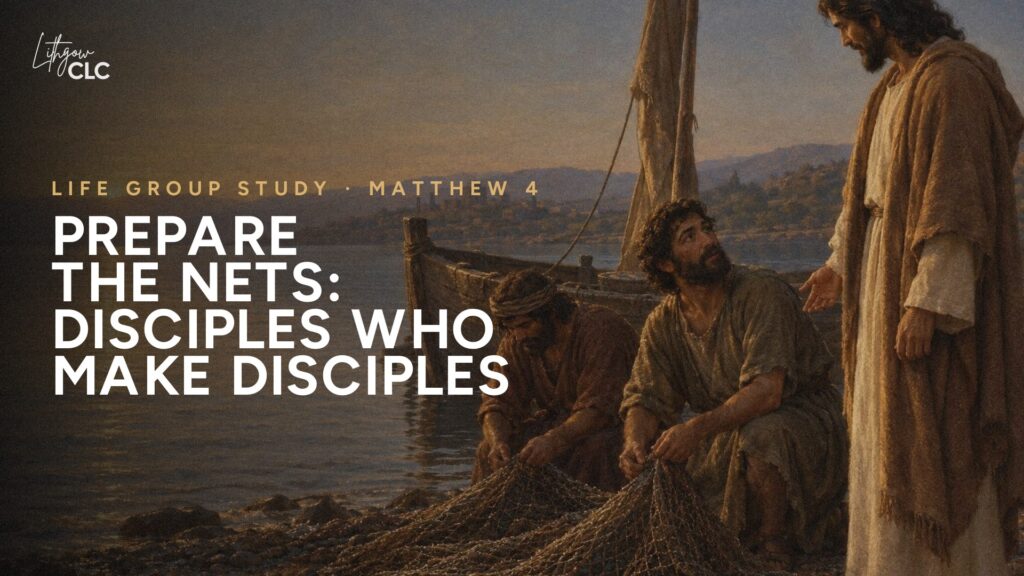
Going on from there, he saw two other brothers, James son of Zebedee, and his brother John. They were in a boat with their father Zebedee, preparing their nets. Jesus called them, and immediately they left the boat and their father and followed him.
This passage is the hinge on which everything else in the Gospels turns. Without these men saying yes, there is no community of disciples to carry the message of the kingdom forward. That same invitation — and that same weight — belongs to us.
Going Deeper
Matthew 4 is carefully structured. Jesus emerges from the wilderness having resisted every temptation to pursue God’s purposes on his own terms. He then moves immediately into public proclamation: “Repent, for the kingdom of heaven has come near.” This is not simply a call to feel sorry for sins. The word translated “repent” is the Greek metanoia — a complete reorientation of mind and direction. And the reason for that reorientation is startling good news: the reign of God has drawn close, not as a distant future hope but as a present reality breaking in through Jesus himself.
It is into this announcement that Jesus recruits his first followers. The Sea of Galilee was a working fishing region, and the men Jesus approaches are not wandering spiritual seekers — they are tradespeople in the middle of a working day. Simon and Andrew are actively casting nets. James and John are in the boat with their father, preparing their nets — mending, cleaning, organising, getting ready for the next catch. The word “immediately” in verse 22 (Greek: euthys) is one of Matthew’s favourite words, carrying a sense of urgency and decisiveness. There is no recorded debate, no request for time to think it over.
What did they see in Jesus that made this possible? At this point in Matthew’s Gospel, the resurrection hasn’t happened. The full identity of Jesus hasn’t been declared. Yet something in his person and his message carried such authority that these men recognised it was worth leaving the security of family, income, and known routine. Jesus reframes their existing skill and identity rather than dismissing it: “I will send you out to fish for people.” Their past is not wasted — it becomes the metaphor for what they are being called into.
This scene also connects to a much wider thread in Scripture. God consistently calls ordinary people out of their ordinary circumstances — Moses from tending sheep, Gideon from threshing wheat, Amos from tending sycamore figs — and sends them into purposes that are larger than themselves. The call is rarely comfortable, and it rarely comes with a complete plan attached. What it comes with is the presence of the One doing the calling.
Andy drew attention to a detail easy to miss: James and John are preparing their nets before Jesus arrives. They are doing the unglamorous, repetitive work that makes the actual fishing possible. Andy used this as a picture of what God may be doing in a season that feels quiet or difficult — not wasting it, but preparing us for what is coming. The season of sitting, mourning, or waiting is not outside God’s purposes. It may be exactly where the nets are being mended.
Discussion
- Look at verses 18–22 again. What details stand out to you about how these men responded to Jesus? What does their response tell us about the kind of authority Jesus carried?
- Jesus announces that “the kingdom of heaven has come near” before he calls anyone to follow him. Why does that announcement matter as the foundation for the call to discipleship? How does it change the way we understand what we are being called into?
- Andy made the point that James and John were preparing nets when Jesus called them — doing the work before the work. What do you think it looks like to be in a season of preparation in your own walk with God? What does that kind of preparation actually involve?
- These disciples left behind financial security, family relationships, and a known future. What has following Jesus cost you — or what might it cost you — that you find genuinely difficult to let go of?
- Andy spoke about wanting the church to move from being disciples to being disciples who make disciples. Honestly, where do you sit with that second part? What gets in the way of you helping someone else grow in their faith?
- Andy also shared the image from 2 Samuel 23 — effort poured out like water on the ground, which becomes an act of worship rather than wasted sacrifice. Is there something in your own life right now that feels like poured-out water? How does that image speak to you?
- Obedience in this passage is immediate and without a complete plan. Where do you sense God is calling you to say yes before you have everything figured out?
Living It Out
- Read the parallel accounts this week. Andy suggested reading Matthew 4, Luke 5, and John 21 together. Sit with all three this week and notice what each account adds. Ask God what he is saying to you personally through the pattern of calling, following, and fishing.
- Name one person you are praying for. Think of someone in your life — family, friend, neighbour — who doesn’t yet know Jesus. Write their name down somewhere you will see it and commit to praying for them daily this week. As Matt and Dian’s testimony showed us, years of faithful prayer are never wasted.
- Take one step toward intentional discipleship. This might be as simple as asking someone from church to catch up for coffee and talk about what God is doing in your lives, or committing to be more present and engaged in a midweek Bible study. Discipleship happens in relationship, not just in Sunday services.
Prayer
Close by praying together for the courage to respond to Jesus’ call with the same decisiveness the disciples showed. Pray for the person each of you named — that God would draw them close. Ask the Holy Spirit to show your group what it means, in this specific season and place, to be disciples who make disciples.
Leader Notes
Timing: The Getting Started question can run long if the group is comfortable with each other — keep it to two or three minutes. Going Deeper is dense; you don’t need to cover every point yourself. Read it beforehand and pull out two or three threads that feel most relevant to your group. The Discussion questions are designed to move from observation toward the heart, so resist the temptation to linger too long on questions 1 and 2.
Likely sticking points: Question 5 about making disciples can produce guilt or defensiveness, particularly in people who feel they don’t have enough Bible knowledge or confidence to disciple anyone. Gently redirect toward relationship — discipleship in the New Testament context is walking with someone, not teaching a curriculum. Andy’s point about the kids in the church needing the adults to invest in them is a helpful, low-pressure entry point for people who feel unqualified.
Pastoral care: Andy shared openly about his own grief following the loss of his daughter Junior thirteen weeks prior. Question 6 about the “poured-out water” image may open up real pain for people in the group who are in their own season of loss or disappointment. Handle this with gentleness and time. It is completely appropriate to slow the study down if someone needs to be heard. The image of worship-not-waste is genuinely pastoral, and the group sitting with someone in their grief is itself an act of discipleship.
The broader series: Andy flagged this as the beginning of a focus on discipleship that will run for roughly the next twelve months. It may be worth naming that for the group — this is an opening conversation, not a one-off challenge. That framing can reduce the pressure to have everything resolved by the end of this session.