
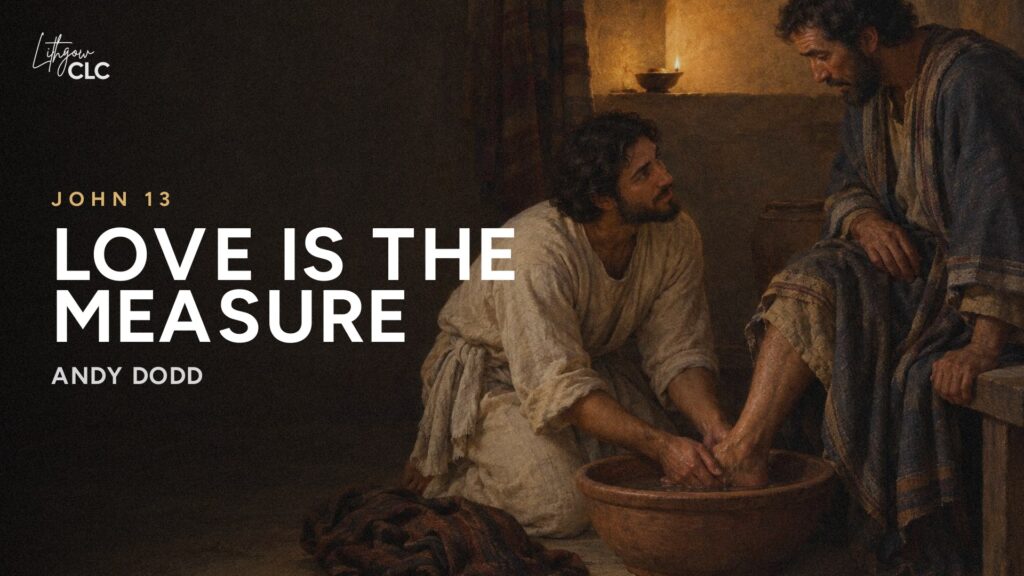

Ps Andy opened the message with a straightforward but searching question: what actually distinguishes a follower of Jesus? Not how long you’ve attended church. Not biblical knowledge, political views or the causes you champion. According to Jesus himself, the answer is love. “By this everyone will know that you are my disciples, if you love one another” (John 13:35). That single verse frames everything.
We’ve heard this before — and that’s the problem
Andy acknowledged something most of us feel but rarely say out loud: after years of sermons about God’s love, it’s easy to switch off when the topic comes up again. But he offered a useful image. God is like a multifaceted diamond. You look at one face and think you understand it, then he shifts it slightly and you see something you’ve never noticed before. The invitation this morning was to let God shift it — to see love not as a familiar slogan but as something that still has the power to challenge and change us.
Paul’s letter to Timothy frames the goal clearly:
The purpose of my instruction is that all believers would be filled with love that comes from a pure heart, a clear conscience, and genuine faith. (1 Timothy 1:5)
All the study, all the teaching, all the theology — it’s supposed to result in us being the most loving people on the face of the earth. That’s a confronting thought. Are Christians in Lithgow known for being the most loving people in town?
God is love, and he defines what love means
Before we can love well, we need to know what love actually is. And here’s the problem: most of us learned what love looks like not from Scripture but from experience — from parents, upbringing, relationships, and the constant stream of messages from songs, films, social media and advertising. Some of those messages are helpful. Many aren’t.
Culture tells us that love is a warm feeling, that love means agreeing with someone, that love should always be returned, that love is for people who are like us. Without realising it, we absorb these ideas and they shape the way we treat people.
But Scripture cuts through all of that. 1 John 4:8 doesn’t say God is loving — it says God is love. Love isn’t just one of his characteristics; it’s his very nature. Which means if we want to understand love, we have to start with God, not with our feelings or experiences.
God’s love is covenantal, not fleeting. It’s grounded in truth, grace, mercy and faithfulness. It’s also holy — it doesn’t pretend sin isn’t an issue. But the remarkable thing is that God’s response to a sinful humanity isn’t abandonment. He comes to rescue. Time after time throughout Scripture we see that pattern: we fall short, he moves towards us. His faithfulness holds even in the face of our unfaithfulness.
God demonstrates his own love for us in this: while we were still sinners, Christ died for us. (Romans 5:8)
God’s love is holy enough to confront our sin, but gracious enough to provide our salvation.
Jesus doesn’t just embody love — he demonstrates it
John 13 puts that love into vivid, physical action. It’s the night before the crucifixion. Jesus knows who he is — he knows the Father has placed all things under his authority, he knows he has come from God and is returning to God. And knowing all of that, he gets up from the table, takes a towel, pours water into a basin, and washes his disciples’ feet.
Foot washing was a lowly act. It was the work of the lowest servant in the household. The person in that room with the greatest authority, the one most worthy of honour, takes the lowest position. Because love is humble.
Do nothing out of selfish ambition or vain conceit. Rather, in humility value others above yourselves, not looking to your own interests but each of you to the interests of the others. In your relationships with one another, have the same mindset as Christ Jesus, who, being in very nature God, did not consider equality with God something to be used to his own advantage. Rather, he made himself nothing by taking the very nature of a servant. (Philippians 2:3–7)
Andy put the question plainly: are there things we consider beneath us? Tasks we think are below our pay grade? Do we sometimes feel we deserve to be treated better than others? Jesus doesn’t insist on his position. He puts the needs of others before his own comfort — and he does it for people he knows are about to fail him. Judas has already decided to betray him. Peter will deny him. The others will scatter. He washes their feet anyway.
Love doesn’t demand repayment. When we serve — in kids’ ministry, on the cleaning team, preparing morning tea, giving our time in a hundred quiet ways — do we do it so someone notices? And if nobody does, do we withdraw? Do we start wondering whether anyone appreciates us? Christlike love isn’t dependent on recognition. In fact, much of what Jesus calls us to will happen where nobody sees it at all.
Love is also action, not just words.
Dear children, let us not love with words or speech but with actions and in truth. (1 John 3:18)
Now you do the same
After washing their feet, Jesus puts his outer garment back on and asks them a question: “Do you understand what I have done for you?” And then he tells them directly:
Now that I, your Lord and Teacher, have washed your feet, you also should wash one another’s feet. I have set you an example that you should do as I have done for you. (John 13:14–15)
He calls himself their Lord and Teacher. He’s their master; they are his learners. And if that’s true — if we actually call him Lord — then his example carries weight. Discipleship isn’t simply accumulating information about Jesus. It’s learning to live like him.
And the distinguishing mark of every disciple is love. Not church attendance, not biblical knowledge, not political views, not ministry involvement. Love.
A new command I give you: love one another. As I have loved you, so you must love one another. By this everyone will know that you are my disciples, if you love one another. (John 13:34–35)
A week-by-week challenge
Andy closed with something refreshingly modest. The goal isn’t to overhaul everything at once. Day by day, God is changing us and making us a little more like Jesus. So the practical challenge for this week is simple: be a little more loving than you were yesterday.
Think about your neighbours — do they know you by your love? Think about your workplace, your family. When someone cuts you off in traffic, what are you known for? Love should be the thing people notice first. Not because we perform it for an audience, but because it flows from a heart that has first received the love of Jesus — the one who got down on his knees and washed the feet of people he knew would fail him, and loved them anyway.