
Getting Started
Think about a skill or habit you had to genuinely work to develop — not just learn about, but actually change how you lived. What made the difference between knowing something and actually being formed by it?
Read the Word
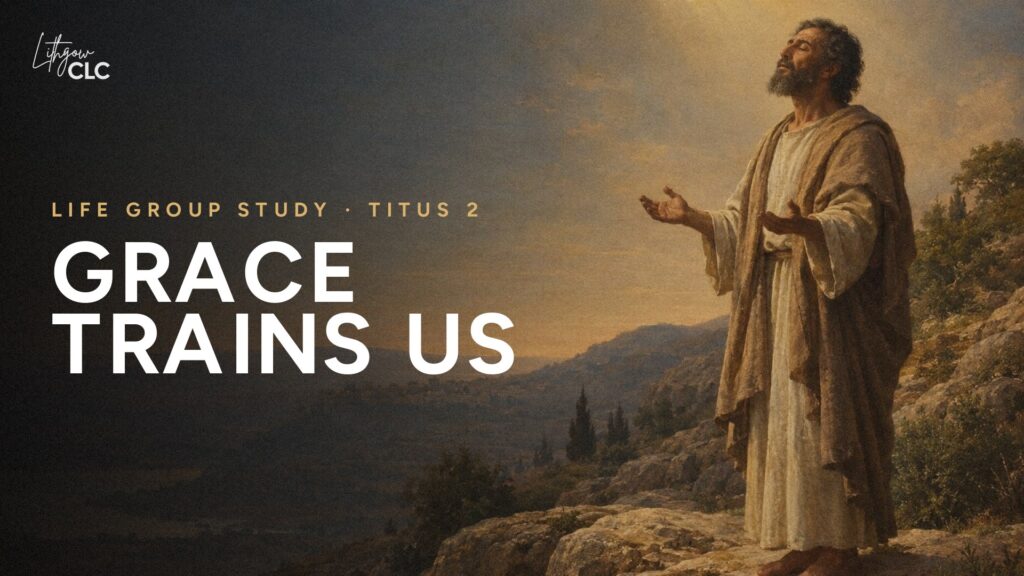
In the message this week, Ps Andy took us to Titus 2:11-14. Read the passage slowly, perhaps twice:
“For the grace of God has appeared that offers salvation to all people. It teaches us to say no to ungodliness and worldly passions, and to live self-controlled, upright and godly lives in this present age, while we wait for the blessed hope — the appearing of the glory of our great God and Saviour, Jesus Christ, who gave himself for us to redeem us from all wickedness and to purify for himself a people that are his very own, eager to do what is good.”
Titus 2:11-14 (NIV)
This short passage holds together two things that are often pulled apart: grace that saves and grace that changes. Paul insists they belong together — and that getting this right shapes everything about how we live as followers of Jesus.
Going Deeper
Titus is a short letter from the apostle Paul to a younger leader named Titus, who has been left on the island of Crete to help establish and strengthen young churches there. The Cretan congregations were surrounded by a culture Paul describes bluntly — and the letter is intensely practical, concerned with what godly life actually looks like on the ground. Chapter 2 is largely about different groups in the church living well, and verses 11-14 land like a theological anchor: all of that practical instruction is grounded not in rules or willpower, but in grace.
The key word in verse 12 is the Greek paideuō — translated “teaches” or “trains.” It carries the sense of the training and discipline a parent gives a child, or a coach gives an athlete. It is not passive information transfer. It is shaping, correcting, forming. Paul is saying that the same grace which saves us is actively at work forming us — it has a training function, not just a forgiving one.
Andy drew out this pattern across the whole passage: grace saves us (v.11), grace trains us (v.12), grace gives us hope (v.13), and grace transforms us (v.14). These are not four separate operations — they are one movement of God’s generous action in our lives.
Andy then placed this alongside the Exodus story, which is the great Old Testament picture of redemption. Israel were slaves in Egypt, unable to save themselves. God rescued them not because of their behaviour but out of his grace — and crucially, that rescue came before the law was given. Belonging came before behaviour. But being rescued out of Egypt did not automatically change the way Israel thought. They still craved what was familiar. They grumbled. They wanted to go back. The wilderness was not punishment — it was formation. God was teaching them to trust, to depend, to live as his people rather than as Pharaoh’s slaves.
Andy made the connection to Romans 8:15, where Paul says believers have received a spirit of adoption, not slavery. The Greek word is huiothesia — adoption into sonship. We are brought into God’s family as his children, not as servants who must earn their place. Yet many of us still carry what Andy called a slave mindset — striving to earn acceptance, hiding failure, living in fear, seeing correction as rejection. The work of grace is to retrain that thinking, to move us from striving to belonging.
This connects to the wider biblical narrative through 1 Peter 2:9, where Peter applies to the church exactly what God declared over Israel in Exodus 19 — a chosen people, a royal priesthood, a holy nation. The purpose of transformation is not merely personal improvement. It is so that we represent God faithfully to the world around us, and ultimately, as Andy noted from Revelation 22, to reign with him in his restored creation. Dallas Willard’s phrase is apt: this life is training for reigning.
Discussion
- Looking at Titus 2:11-14, what surprises you about the role Paul gives to grace here? How does it compare with how you normally think about grace?
- Andy described the Hebrew word for sacrifice — corban — as meaning “draw near.” How does understanding Jesus’ sacrifice as the means by which we draw near to God change how you think about your relationship with him day to day?
- The Exodus story shows that Israel were rescued before they ever lived like God’s people — belonging came before behaviour. Where have you seen this pattern in your own experience of coming to faith?
- Andy listed a series of contrasts between a slave mindset and a son-or-daughter mindset — things like “I must earn my acceptance” versus “I receive God’s love through Christ,” or “correction means rejection” versus “love and correction help me grow.” Which of those contrasts lands closest to home for you, and why?
- The adopted daughter in the story eventually felt safe enough to say no to a jam sandwich — a sign that she had begun to trust her new reality. What might it look like in your own life to start acting from a place of security rather than scarcity or fear?
- Andy said God transforms us not just for our own benefit, but so we can represent him to the world. Where in your current relationships or circumstances is there an opportunity to reflect God’s grace to someone this week?
Living It Out
- Identify one pattern. Choose one area where you notice yourself thinking or responding like a slave rather than a son or daughter of God — perhaps fear, the need for recognition, or hiding failure. Name it honestly before God this week, and ask the Holy Spirit to begin retraining your thinking in that area.
- Replace the lie with truth. Find one verse this week that speaks directly to that pattern and read it daily. Let God’s word do the retraining work that Andy described — not just information you know, but truth you are letting reshape how you think and respond.
- Show grace to someone concretely. Choose one person in your life — at home, at work, in the neighbourhood — and look for a specific way to show them patience, forgiveness, encouragement or service this week. Grace that transforms us should flow outward.
Prayer
Close by praying together, thanking God that his grace is not only the means of our salvation but the ongoing power that trains and forms us. Ask the Holy Spirit to reveal where slave-mindset thinking is still at work, and to give each person in the group courage to receive correction, trust the Father’s love, and live this week from a place of belonging.
Leader Notes
Timing: The Getting Started question should move quickly — two or three minutes. Give the bulk of time to Discussion questions 4 and 5, which are the most personally searching. Question 4 in particular may surface things people have not put into words before, so leave unhurried space there.
Going Deeper: If your group is less familiar with background material, you can summarise this section rather than reading it aloud in full. The key concepts to land are: grace has a training function (paideuō), belonging precedes behaviour, and the Exodus pattern applies to us.
The slave-mindset list: Andy’s list of contrasts is rich material, but do not try to work through all of them in discussion. Question 4 asks people to pick what lands closest — trust the group to surface what is most alive. Resist the urge to process every contrast.
Pastoral care: Question 5 touches on experiences of deprivation, early family life, or backgrounds where love was conditional. Some group members may carry real pain here. If someone shares something significant, acknowledge it warmly before moving on, and follow up pastorally during the week. Andy’s story of the adopted daughter is a helpful, gentle way in to this territory — reference it if the conversation needs grounding.
The “why bother” question: Andy raises directly whether, if we are saved by grace, there is any reason to pursue transformation. This is a genuinely important theological question and some in your group may have wondered it themselves. The answer from Ephesians 2:8-10 is key: saved by grace through faith, yes — but created in Christ Jesus for good works. Both are true together. Hold that tension carefully rather than collapsing it in either direction.