
Getting Started
Think of a time you were absolutely convinced you understood something, only to discover later you had the picture only half right. What was it like to realise you needed to rethink your position?
Read the Word
In the message this week, Ps Andy took us to two key passages. Read them aloud together.
Luke 6:39-40
He also told them this parable: “Can the blind lead the blind? Will they not both fall into a pit? The student is not above the teacher, but everyone who is fully trained will be like their teacher.”
Mark 8:22-25, 27-35
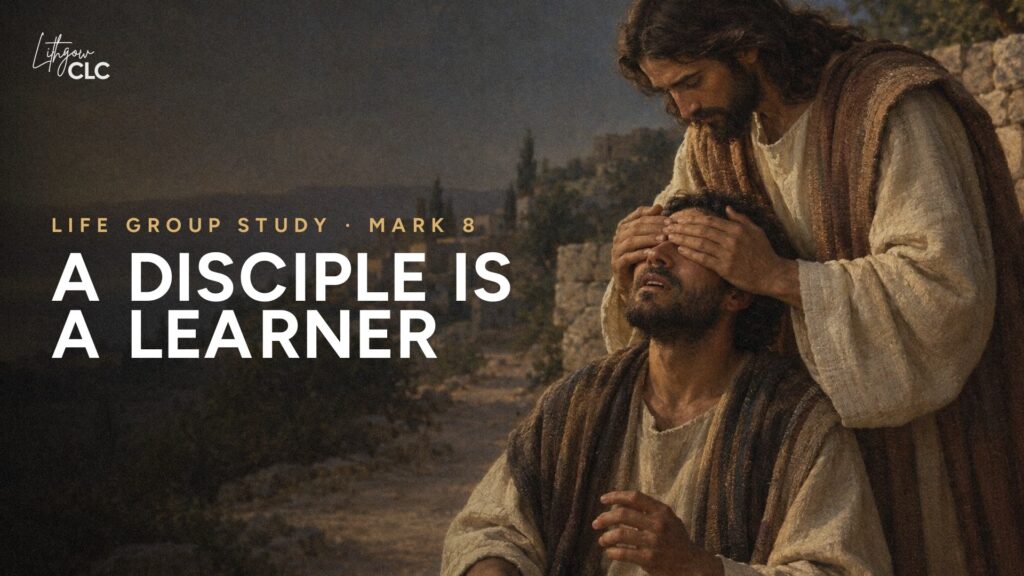
They came to Bethsaida, and some people brought a blind man and begged Jesus to touch him. He took the blind man by the hand and led him outside the village. When he had spat on the man’s eyes and put his hands on him, Jesus asked, “Do you see anything?” He looked up and said, “I see people; they look like trees walking around.” Once more Jesus put his hands on the man’s eyes. Then his eyes were opened, his sight was restored, and he saw everything clearly.Jesus and his disciples went on to the villages around Caesarea Philippi. On the way he asked them, “Who do people say I am?” They replied, “Some say John the Baptist; others say Elijah; and still others, one of the prophets.” “But what about you?” he asked. “Who do you say I am?” Peter answered, “You are the Messiah.” Jesus warned them not to tell anyone about him. He then began to teach them that the Son of Man must suffer many things and be rejected by the elders, the chief priests and the teachers of the law, and that he must be killed and after three days rise again. He spoke plainly about this, and Peter took him aside and began to rebuke him. But when Jesus turned and looked at his disciples, he rebuked Peter. “Get behind me, Satan!” he said. “You do not have in mind the concerns of God, but merely human concerns.” Then he called the crowd to him along with his disciples and said: “Whoever wants to be my disciple must deny themselves and take up their cross and follow me. For whoever wants to save their life will lose it, but whoever loses their life for me and for the gospel will save it.”
These two passages sit deliberately side by side in Mark’s Gospel. The way Mark arranges them is itself part of the message: how we see shapes what we do, and partial sight can be more dangerous than blindness.
Going Deeper
Mark is a carefully structured Gospel, and he places the healing of the blind man at Bethsaida as a hinge between two major sections. Up to this point, the disciples have been watching miracle after miracle but still struggling to grasp who Jesus really is. Immediately after the healing, Peter makes his great confession — “You are the Messiah” — which looks like a breakthrough moment. And it is. But Mark is not finished.
The blind man’s healing happens in two stages. Jesus touches him once and the man sees partially — people who look like trees. A second touch brings full clarity. Bible scholars have long recognised that Mark places this story directly before Peter’s confession to make a point: Peter, like the blind man, has received genuine sight, but his vision is not yet complete. He can see that Jesus is the Messiah. What he cannot yet see is what kind of Messiah Jesus is.
When Jesus begins to explain that the Messiah must suffer, be rejected, and be killed before rising again, Peter does something remarkable. He pulls Jesus aside and rebukes him. The word Mark uses is the same word used elsewhere for rebuking demons. Peter is not gently disagreeing; he is telling Jesus he has got it wrong. And Jesus’s response is sharp: “You do not have in mind the concerns of God, but merely human concerns.”
Peter’s problem is not that he has seen nothing. It is that he has seen enough to feel confident, but not enough to see clearly. This is exactly the dynamic Andy described from the Dunning-Kruger research — a little knowledge can produce great confidence, and that confidence can actually close us off to learning more.
The Greek word translated “disciple” is mathetes, which simply means a learner, a student, an apprentice. In the ancient world, a disciple did not merely attend a teacher’s lectures. They followed the teacher’s daily life, absorbed their habits of thought, imitated their practices, and were shaped over time into someone who resembled the master. Luke 6:40 captures this exactly: “Everyone who is fully trained will be like their teacher.” The goal of discipleship is not accumulating correct beliefs. It is becoming like Jesus — in the way we think, respond to difficulty, love people, and depend on the Spirit.
The Bereans in Acts 17 offer a healthy model. When Paul preached to them, they did not simply accept or reject what he said. They received the message eagerly and then examined the scriptures daily to test whether it was true. Their willingness to question and investigate did not undermine faith; it deepened it. Many came to believe precisely because they were willing to look carefully rather than assume they already knew.
Andy made the point that information is not the same as formation. We can watch cooking videos without learning to cook. We can hear sermons without being changed. Real learning requires engagement, reflection, correction, and practice. As 2 Corinthians 3:18 reminds us, this transformation into the likeness of Christ is ultimately the Spirit’s work — but it requires us to remain genuinely open to being taught.
Discussion
- Looking at the two-stage healing of the blind man, why do you think Mark places this story immediately before Peter’s confession? What is he trying to show us about the nature of understanding?
- Peter had just correctly identified Jesus as the Messiah, yet moments later Jesus rebuked him sharply. What does this tell us about the difference between having the right answer and truly understanding what that answer means?
- Andy drew a distinction between information and formation. In your own experience of following Jesus, where have you noticed that gap? When did knowing something not actually change you, and what eventually did?
- The Bereans questioned even Paul, and their questioning led to greater faith. What makes it feel risky to ask hard questions about our faith, and what might we be missing when we avoid those questions?
- Andy mentioned that remaining open to learning means being willing to discover we have been wrong about something. Where in your life right now do you sense God might be pressing on an assumption or blind spot? What makes it difficult to remain open there?
- Luke 6:40 says the fully trained disciple will be like their teacher. When you honestly compare the way you think and respond to people and situations with the way Jesus did, what is the clearest gap you notice?
Living It Out
- Ask one question this week. Identify something about your faith or your understanding of Jesus that you have always accepted without examining closely. Spend some time in the scriptures or in conversation with a trusted friend actually investigating it. Come to next week’s gathering ready to share what you found.
- Practise the disciple’s prayer. Each morning this week, before you open your phone or begin your day, ask one simple question: “Jesus, what are you trying to teach me today?” Keep a note of what surfaces during the day in response to that question.
- Invite correction. Choose one relationship — a spouse, a close friend, or someone in this group — and genuinely ask them where they see a blind spot in you. Listen without defending yourself, and bring what they say to God in prayer.
Prayer
Close by praying together along these lines: thank God that he is patient with partial sight, just as he was with Peter and the disciples. Ask him to show each person in the group where their vision is incomplete, and pray for the humility and courage to remain open to being taught. You might use Andy’s closing prayer from the message as a guide: “Lord, what are you trying to teach us? What are you trying to form in us? We commit ourselves again to walking with you.”
Leader Notes
Timing: Getting Started should move quickly — keep it to two or three minutes. The Going Deeper section is designed to be read aloud by the leader or shared around the group; resist the temptation to expand it into a mini-lecture. Save the bulk of your time for Discussion questions 3, 5, and 6, which are where the most significant personal reflection tends to happen.
Likely sticking points: Question 4, about questioning faith, can feel threatening in a church context. Reassure the group that the Bereans are held up in scripture as a model, not a cautionary tale. Examining what we believe and why is not the same as doubting God. Andy made this point clearly, and it is worth restating if people seem hesitant.
Question 5 needs pastoral care. Asking people to name a current blind spot is genuinely vulnerable territory. Do not rush it, and do not force anyone to share publicly. You might model vulnerability yourself by naming something from your own life first. If someone shares something significant, make sure the group responds with grace rather than advice.
The Dunning-Kruger reference in Going Deeper is kept brief intentionally. If group members want to discuss it further, it can be a helpful conversation, but keep steering the discussion back toward the scriptural point: confidence is not the same as clarity, and Peter is the example of that in the text.
For smaller or less talkative groups: Questions 1 and 2 can be combined into a single observation question to save time. Focus your energy on questions 3, 5, and 6 where the personal reflection is richest.