
Getting Started
Think of a time when you were genuinely at the end of your resources — emotionally, financially, physically, or relationally. What did you find yourself looking to for reassurance?
Read the Word
In the message this week, Ps Chris Smith took us to 1 Kings 17:8–16. Read it carefully as a group:
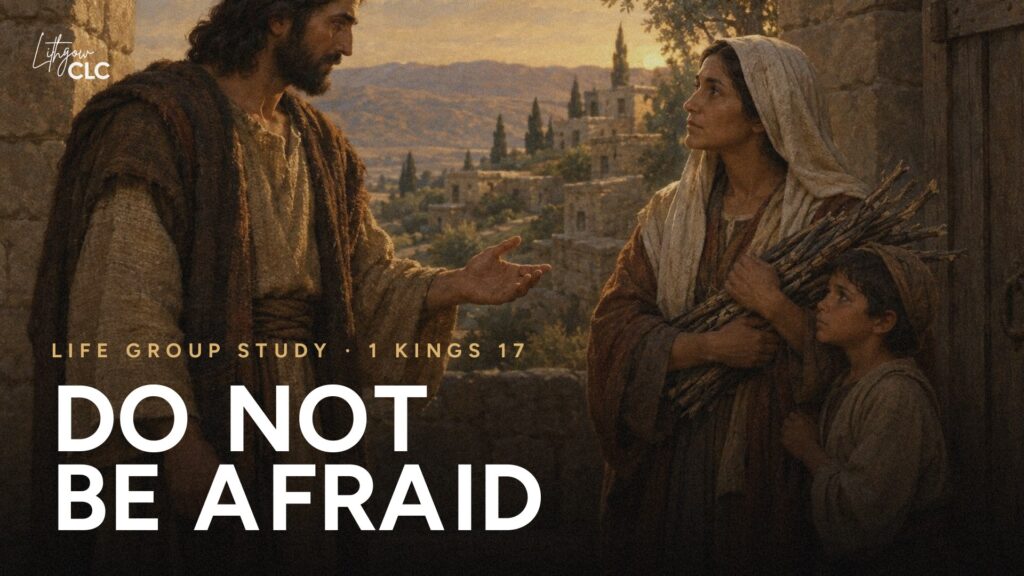
Then the word of the Lord came to Elijah: “Go at once to Zarephath in the region of Sidon and stay there. I have directed a widow there to supply you with food.” So he went to Zarephath. When he came to the town gate, a widow was there gathering sticks. He called to her and asked, “Would you bring me a little water in a jar so I may have a drink?” As she was going to get it, he called, “And bring me, please, a piece of bread.”
“As surely as the Lord your God lives,” she replied, “I don’t have any bread — only a handful of flour in a jar and a little olive oil in a jug. I am gathering a few sticks to take home and make a meal for myself and my son, that we may eat it — and die.”
Elijah said to her, “Don’t be afraid. Go home and do as you have said. But first make a small loaf of bread for me from what you have and bring it to me, and then make something for yourself and your son. For this is what the Lord, the God of Israel, says: ‘The jar of flour will not be used up and the jug of oil will not run dry until the day the Lord sends rain on the land.'”
She went away and did as Elijah had told her. So there was food every day for Elijah and for the woman and her family. For the jar of flour was not used up and the jug of oil did not run dry, in keeping with the word of the Lord spoken by Elijah.
1 Kings 17:8–16 (NIV)
This passage sits in the middle of one of Israel’s darkest seasons. It shows us that the God who commands “do not be afraid” backs those words with concrete, daily faithfulness to the most overlooked people imaginable.
Going Deeper
To feel the weight of this story, we need to understand its setting. Israel is under King Ahab, whose reign the Bible describes as more wicked than any king before him. Elijah has just announced a drought as divine judgement on Ahab’s idolatry. This is not a gentle dry spell — it is a multi-year famine that grinds down the whole region.
Zarephath is significant. It sits in Sidon, which was Jezebel’s home territory. Jezebel, Ahab’s queen, had imported Baal worship into Israel — and Baal was the Canaanite storm god, supposedly the one who brought rain and guaranteed harvests. God is making a pointed statement: in the very region where Baal is worshipped as the provider, the God of Israel is going to demonstrate who actually provides.
The widow herself is as marginal as it gets. She is a Gentile, a woman, and a widow in an ancient economy that offered widows almost no security. She has no land, no income, no stored grain. When Elijah finds her, she is collecting sticks to cook what she has openly named as her last meal. The phrase “that we may eat it and die” is not dramatic exaggeration — it is a sober statement of her situation.
God’s instruction to Elijah is striking: he has to walk roughly 137 kilometres to reach her. There was nothing accidental about the timing. Chris pointed out in the message that Elijah arrives on the very day she faces her final meal — not a week earlier, not a day later. That precision is worth sitting with.
Elijah’s first words to her — “Do not be afraid” — come from a complete stranger asking her to give away the last food she has. The command is almost offensive in context. Yet the Hebrew behind “do not be afraid” (al tira) is the same phrase God uses throughout the Old Testament at moments of divine intervention. It signals that God himself is present in this moment, not just a travelling prophet.
Then comes the daily provision. Chris drew attention to something easy to miss: God did not give her a barrel of flour and a barrel of oil. He gave her a jar and a jug that simply never ran empty. Each day she would reach in and find enough for that day. This is the same pattern Jesus teaches in the Lord’s Prayer — “give us today our daily bread.” God’s method of provision is often designed to keep our eyes on him rather than on our stockpile.
Finally, we should notice that God sent his prophet to a Gentile widow at all. Jesus himself highlights this in Luke 4:25–26, pointing out that there were many widows in Israel during Elijah’s time, yet God sent him to this woman in Sidon. The reach of God’s care exceeds every boundary we might draw around it.
Discussion
- What details in this passage make the widow’s situation feel genuinely hopeless rather than just difficult? Why does that matter for how we read the miracle?
- God sends Elijah 137 kilometres to reach one Gentile widow on one specific day. What does that precision tell us about how God relates to individuals?
- Chris noted that God provided through a daily jar and jug rather than a large stored supply. Why do you think God might choose to provide in ways that require us to return to him each day rather than ways that would let us feel self-sufficient for a season?
- Elijah tells the widow “do not be afraid” before there is any visible reason not to be afraid. Where in your own life are you being asked to trust a promise before you can see the evidence?
- The widow obeys an instruction that makes no logical sense — give your last food to a stranger. What makes that kind of obedience so hard, and what does her response suggest about where trust actually lives?
- Chris connected God’s name “I AM” from Exodus 3 to this story — the God who cannot be limited or fully described. How does holding that picture of God change the way you pray about something you are currently facing?
- Is there an area of your life right now where your faith is sitting in what you can measure — the barrel you can see — rather than in the God who refills the jar?
Living It Out
- Name one specific fear or need this week and pray it back to God daily. Rather than praying once and moving on, bring it back each morning as a deliberate act of saying “I am looking to you today, not to what I can see in the cupboard.”
- Practise obedience in one thing that doesn’t yet make sense. The widow acted before she saw the result. Identify one step of faithfulness you have been putting off because the outcome isn’t guaranteed, and take it this week.
- Share the provision you do see. The widow’s miracle was daily and ordinary — flour and oil, not gold. Pay attention this week to the ways God is providing in undramatic, everyday forms, and tell someone about one of them.
Prayer
Close by inviting group members to pray briefly and honestly about one thing they are finding it hard not to fear. Encourage prayers that name God as “I AM” — the one who cannot be limited by our circumstances. You might open with something like: “Lord, we bring you the things we are tempted to carry alone. You are I AM, and you know what we need before we speak it. Help us to look up.”
Leader Notes
Timing: Getting Started should move quickly — keep it to two or three minutes. Going Deeper is written for you to summarise conversationally rather than read aloud; pick the details that feel most alive to your group. The Discussion questions are the heart of the session. Questions 4 and 7 are the ones most likely to produce genuine personal reflection, so protect time for them even if earlier questions run long.
Likely sticking points: The gap between “God will provide” and lived experience of unanswered prayer is real and your group will feel it. Chris was careful in the message not to promise that every miracle comes immediately or in the form we expect. If this tension surfaces, hold it honestly — the widow’s provision was daily and undramatic, not a sudden reversal of all hardship. The story normalises trust through sustained difficulty, not just trust that ends difficulty quickly.
Pastoral care: There may be people in your group carrying serious medical situations, financial stress, or grief. Question 4 in particular can open up raw material. Be ready to slow down and pray specifically for individuals rather than pressing through the remaining questions. The prayer time at the end of the session can be extended as needed. If someone shares something significant, follow up personally during the week rather than leaving it in the room.
On the Gentile widow: Some group members may find it surprising or even unsettling that God bypassed Israel to care for a foreign woman. If that comes up, it is worth noting that Chris pointed to this as evidence of the breadth of God’s care — and that Jesus himself used this story to challenge the assumption that God’s reach is limited to insiders. That can be a fruitful moment for missional reflection about who in your community might feel as overlooked as this widow did.